
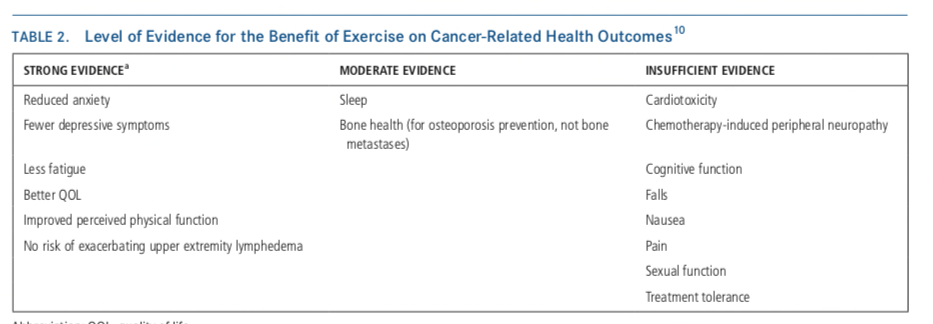
Physical activity has profound benefits for cancer patients; however, cancer patients are not getting enough PA to achieve these health benefits 1,2,3 (image of checklist showing the cancer-related health outcomes benefits by PA – Table 1). Oncologists hold a unique position, as they are highly trusted by patients and patients would be more motivated to exercise if recommended by their oncologist 4. However, oncologists do not regularly discuss PA with patients 5.
Not only do patients benefit, but so do oncologists. What’s in it for oncologists? Exercise has the potential to improve oncologists planned course of treatment and treatment effectiveness.
- There is potential for exercise to improve treatment tolerance, specifically some evidence of improved chemotherapy completion rate; increased intensity of dose and reduced dose adjustments 1,6.
- There is strong evidence demonstrating improved survival for breast, prostate and colon cancer 3. This has yet to be established for other cancer types but may have the same effect.
- Preliminary evidence in animal studies shows the potential role in exercise altering tumor biology, such as improved vascularization of tumors which could improve delivery of chemotherapies to tumors. There is also evidence of tumor suppressor genes being activated and increased apoptosis of tumors, among other impacts on the hallmarks of cancer 2.
These are just some of the profound ways exercise can impact course of treatment, with evidence in this field continuing to emerge.
A webinar series would be an effective and efficient method to train oncologists on PA for cancer survivors, so they can improve treatment. These webinars will address knowledge of the PA guidelines, types, amounts, intensity and timing 2. It will also address, contraindications, safety, and strategies to assess, advice and refer patients 3. Knowledge is powerful and this knowledge can help oncology profoundly.
Interested in learning more? Please visit https://oncologypapractices.law.blog. Your feedback and suggestions are valuable!
Appendix
Table 1. Benefits of Exercise for Cancer-Related Health Outcomes (Schmitz et al., 2019)
References
- Campbell, K. L., Winters-Stone, K. M., Wiskemann, J., May, A. M., Schwartz, A. L., Courneya, K. S., … & Morris, G. S. (2019). Exercise guidelines for cancer survivors: consensus statement from international multidisciplinary roundtable. Medicine & Science in Sports & Exercise, 51(11), 2375-2390.
- Patel, A. V., Friedenreich, C. M., Moore, S. C., Hayes, S. C., Silver, J. K., Campbell, K. L., … & Denlinger, C. (2019). American College of Sports Medicine roundtable report on physical activity, sedentary behavior, and cancer prevention and control. Medicine & Science in Sports & Exercise, 51(11), 2391-2402.
- Schmitz, K. H., Campbell, A. M., Stuiver, M. M., Pinto, B. M., Schwartz, A. L., Morris, G. S., … & Patel, A. V. (2019). Exercise is medicine in oncology: engaging clinicians to help patients move through cancer. CA: a cancer journal for clinicians, 69(6), 468-484.
- Jones, L. W., Courneya, K. S., Fairey, A. S., & Mackey, J. R. (2004). Effects of an oncologist’s recommendation to exercise on self-reported exercise behavior in newly diagnosed breast cancer survivors: a single-blind, randomized controlled trial. Annals of Behavioral Medicine, 28(2), 105-113.
- Hardcastle, S. J., Kane, R., Chivers, P., Hince, D., Dean, A., Higgs, D., & Cohen, P. A. (2018). Knowledge, attitudes, and practice of oncologists and oncology health care providers in promoting physical activity to cancer survivors: an international survey. Supportive Care in Cancer, 26(11), 3711-3719.
- Bland, K. A., Zadravec, K., Landry, T., Weller, S., Meyers, L., & Campbell, K. L. (2019). Impact of exercise on chemotherapy completion rate: a systematic review of the evidence and recommendations for future exercise oncology research. Critical reviews in oncology/hematology.
 Enhancing Physical Activity Discussion Practices in Oncologists & Oncology Healthcare Providers